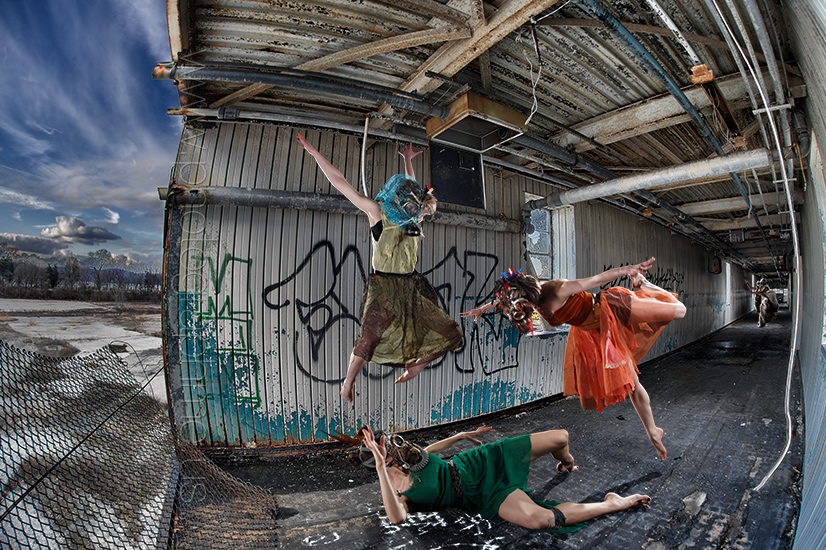
On Tuesday evening I will perform with the inspirational dancer Korhan Basaran in a collaborative improvisation. The music, derived from the D Minor Partita of J.S. Bach, will begin in an abstract state of “D-ness” and move gradually toward a complete realization of Bach’s Ciaccona.
After our set, Cori Kresge will present a new dance piece, Sapience I-X “Human Story.” Sapience I-X “Human Story,” portrays a dystopian vision of a future world where no animal species remain. Since humans have nothing against which to measure their own humanity, they must find new ways to define themselves collectively and individually.
Imaginary Friends at the Gershwin Hotel Tues April 26 at 8pm
7 E 27th st between 5th and Madison Aves
$15 tix at the door
I have posted two new documents here which build upon the concepts we discussed at the combined Rep Class on April 6. First, here is a reference guide for the harmonic series on violin and viola (also works for Cello and Bass, with octave transpositions). Study it for a deeper understanding of the relationship of the strings on our instrument, and keep it around as a quick reference sheet if questions about harmonics arise in your repertoire.
Next, here is a revised and expanded version of the Practical Examples sheet I handed out on April 6. Based on our discussion, I added an alternate intonation plan for the Bach B Minor which proposes that you match pitch to open string whenever possible. On the second page, you will find one possible intonation interpretation for the Bach Ciaccona. Notice how dissonant the overtones are! This is why the Ciaccona is so dark, and also why it is a difficult piece to play in tune.
Click below to download the Drone Meditation pdf. Give it a try in your personal practice, and adapt it as a quartet warmup. Treat the printed material as a “lead sheet” for improvisation. The goal is to feel relaxed, to open your ears, and have the freedom to express. Remember to check Just Intonation intervals against natural harmonics until you really feel comfortable with the way the overtones align.
In Violin Yoga Class on Monday and Wednesday this week, we listened to several incredible works from the past three decades, each of which has had a profound effect on my artistic self. I am posting links to recordings here, I urge you to give another listen.
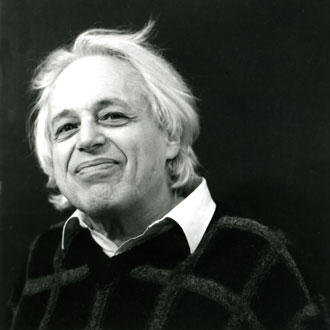
György Ligeti’s Concerto is an incredible achievement of violin writing, and is on the cusp of being accepted in the standard repertory with the likes of Berg, Sibelius, and Beethoven. Before he began composing the piece, Ligeti studied the solo literature of Bach, Paganini, Wieniawski, and Ysäye in order to gain an intimate understanding of the mechanics of the violin. The result of his efforts is a solo part which stretches our concept of the violin’s capabilities without presenting anything beyond the realm of possibility.
I found this excellent recording of Sayaka Shoji performing the Ligeti Concerto on YouTube. It is inspiring to see her deft navigation of all the technical challenges on video.
The recording we listened to in class remains my favorite, with Frank Peter Zimmermann, violin solo, and Asko Ensemble. They have it in the IC Library, call number CD7688v.3.
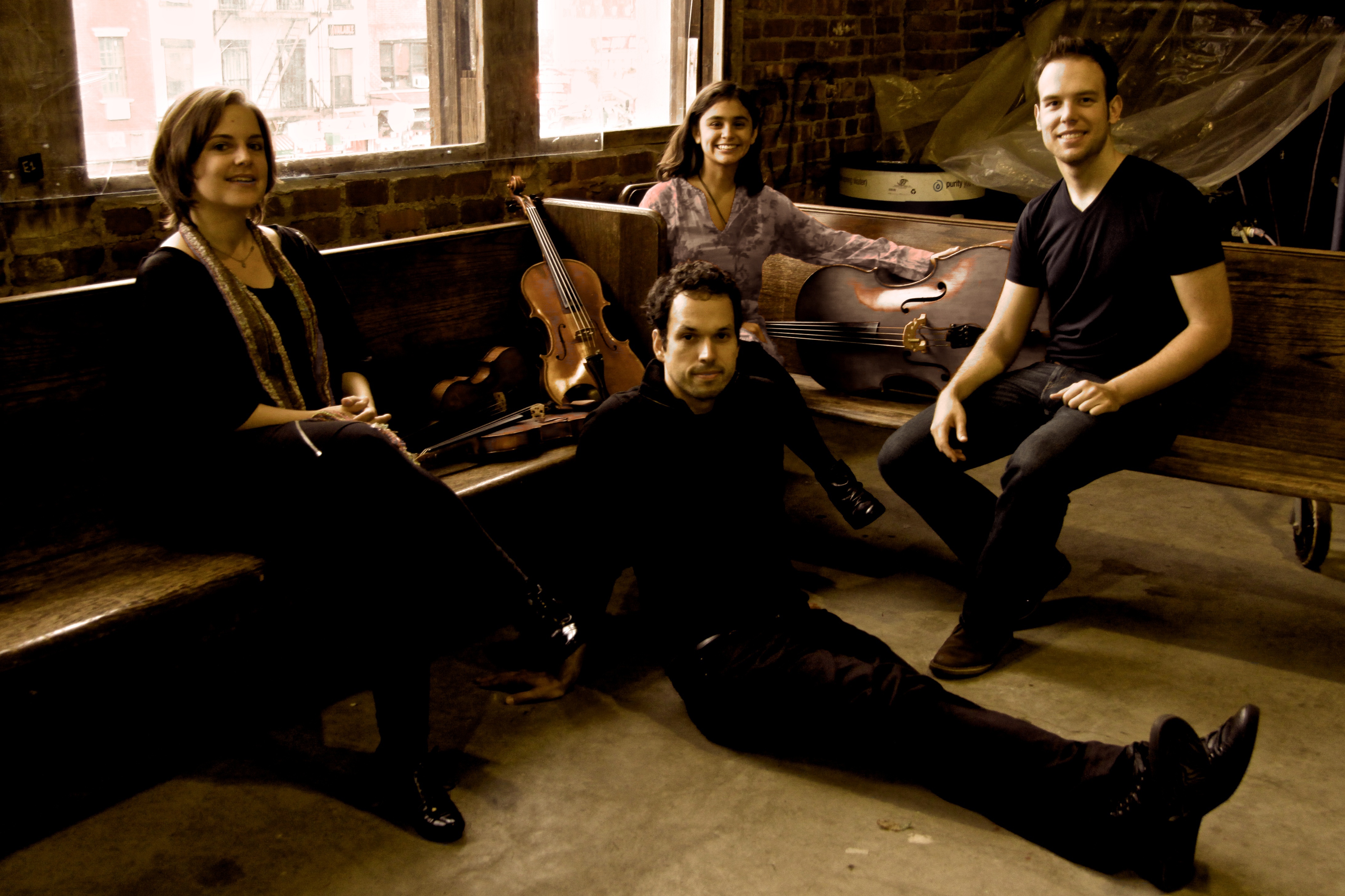
MIVOS Quartet
On Wednesday, we listened to Wolfgang Rihm’s Fourth String Quartet, First Movement (performed by MIVOS Quartet), and Eric Wubbels’ Euphony, for large ensemble (performed by Wet Ink). Wolfgang Rihm is often referred to as a “Neo-Romantic” or “New Simplicity” composer. New Simplicity, a bit of an overstatement, refers to a return to raw emotional expression and a reaction to the New Complexity Movement. To me, Rihm’s music is a mashup of the hyper-romanticism of Berg, the heart of Mahler, and the meticulous cellular design of Beethoven, all retooled and reimagined for our time.
Here I’ve posted the First Movement, recorded by MIVOS Quartet in 2010:
Rihm 4: First Movement
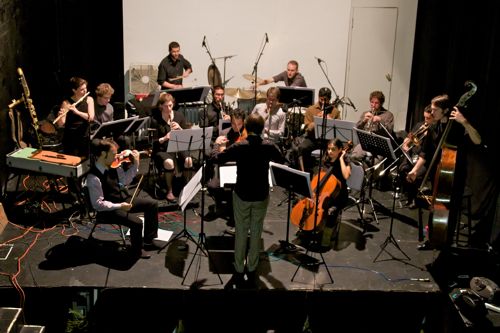
Wet Ink Ensemble
Eric Wubbels is one of several composers in NYC who continually renews my belief in art. He has a bunch of outstanding recordings posted on his website. Check out “Euphony”, “This Is, This Is, This Is”, and “Shiverer.”
I’m back at my Alma Mater once again this coming week for some substitute teaching (Apr 17-23). I’m extremely honored to be filling in for Prof. Nick DiEugenio. In addition to covering teaching responsibilities for the week, I’ll be doing a series of lectures during Nick’s Violin Yoga Class time (topics will include acoustics and contemporary violin techniques as related to inner pulse awareness and other kinesthetic aspects of music making).
I’m going to finally make a legitimate effort to do some blogging, and will be posting resources for students on this webpage throughout the week.
I’m at my Alma Mater for the week, and very excited to be sharing some contemporary music. This trip I’m going to be working with the violin students on some acoustic concepts and premiering Dillon Kondor’s new violin concerto, for chamber ensemble and improvising soloist, with the Ithaca College Contemporary Ensemble.
A couple weeks ago I was at IC for a recital of recent solo violin works (Berio, Ferneyhough, Pierzak, Shai, Brook, Feldman). The community in Ithaca is so receptive to new sounds, it was really inspirational.
If you’re in the finger lakes region this week, come check out the concert!
Ithaca College Contemporary Ensemble
Wednesday, Apr 6, 8:15PM
Hockett Recital Hall, Ithaca College
free admission
Wet Ink Columbia University Residency – Fall Premieres: Part 2
St Peters Church
Saturday December 11, 2010 – 8pm
Wet Ink’s residency at Columbia University will include five world premieres for large ensemble by New York City based composers as well as Alex Mincek’s large scale electro-acoustic work Pendulum. From the sweeping orchestral textures of composers like Mika Pelo and Geof Holbrook to the sound explorations of Brahim Kerkour and Yoshiaki Onishi to the multimedia experimentations of Josh Cody this large ensemble concert looks to be a highlight of the fall concert season in New York.
Program:
Brahim Kerkour – New Work
Mika Pelo – Cloudy
Geof Holbrook – Future Perfect
Alex Mincek – Pendulum V
Yoshi Onishi – Palinody
Joshua Cody – Good Men and Good Women
I’m thrilled to be performing Berio’s Sequenza VIII for solo violin on Issue Project Room’s first Darmstadt Essential Repertoire concert. The series highlights some of the seminal works of the latter-half of the 20th Century. This year’s debut concert includes the first 10 of Berio’s Sequenzas for solo instruments. Sequenza VIII has a lot of meaning to me as a violinist and as a musician; it’s great to have this opportunity to revisit it. I am honored to be sharing the stage with some of NYC’s finest, including Claire Chase, Stephen Gosling, John Pickford Richards, Gareth Flowers, Shelley Burgon, Daisy Press, Chris McIntyre, Joshua Rubin, and James Austin Smith.
On November 3rd, Wet Ink will give its first concert of premieres for chamber septet @ Symphony Space. The program will feature works by Katharina Rosenberger, Rick Burkhardt, Ian Power, Kate Soper, Sam Pluta, and Alex Mincek. The Wet Ink septet is:
Kate Soper, voice; Erin Lesser, flutes; Alex Mincek, saxes; Ian Antonio, percussion; Eric Wubbels, piano; Joshua Modney, violin; Sam Pluta, electronics.
We will be joined by Eliot Gattegno on alto sax. Hope to see you there!
Wet Ink Ensemble received a nice review in the New York Times for our July concert at Columbia University’s Jazz Composer’s Orchestral Insitute (read the full review here). The week-long festival was a real treat; we got to share our expertise on contemporary instrumental techniques with some amazing jazz musicians, and had the opportunity to perform great large-ensemble music by some of my favorite composers (Eric Wubbels, Bernhard Lang, Katharina Rosenberger, Leroy Jenkins).
It was particularly exciting for me to be making my debut as free-jazz violin soloist in Leroy Jenkins’ quasi-concerto, Wonderlust. The review of Wonderlust is excerpted below:
“Among the works Wet Ink played… “Wonderlust” by Leroy Jenkins, embraced jazz improvisation as a primary concern. Joshua Modney, a violinist, played a flamboyant solo part over an ensemble mostly deployed as accompaniment.”

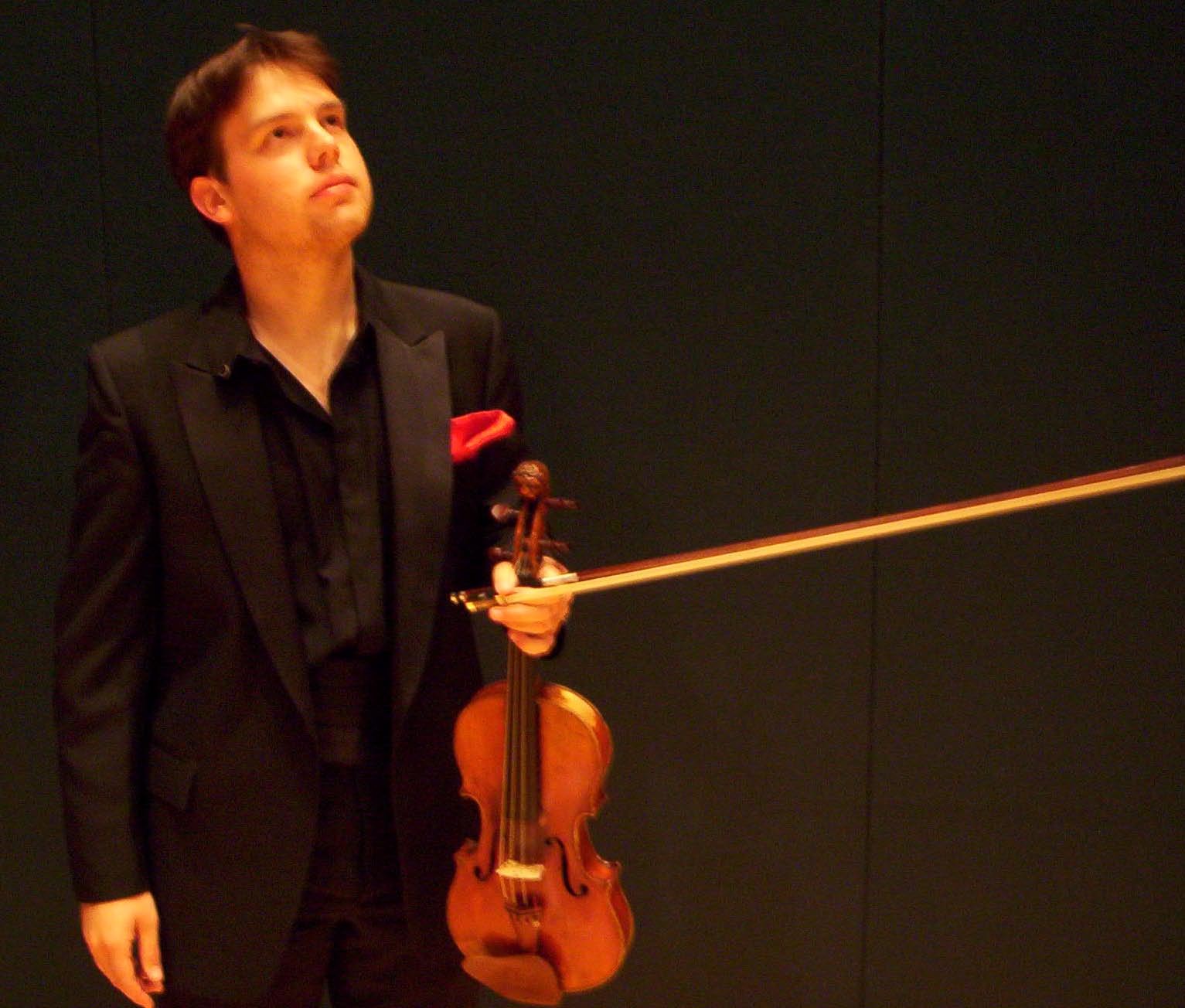
 MODNEY